

WAIT… Why Am I Talking?
On oversharing, awkward silences, and the agonizing art of saying less in session.

There’s a moment in almost every therapist’s career when you realize, mid-sentence, that you’ve been talking for far too long about something that has absolutely nothing to do with your client.
It starts innocently enough.
You’re sitting with a client who feels unseen. They mention something about their dad always disappearing around the holidays, and suddenly you feel it. That pull. That ache of shared experience. And before you know it, you’re halfway into a story about your own father (who’s still using dial-up to connect emotionally), only to look up and realize your client has gone completely still. Not engaged still, but rather What-is-happening still.
You’ve made it about you.
Now, you didn’t mean to. You were just trying to connect. To normalize. To reassure. And connection can be a slippery slope for therapists and therapist types, especially when we pride ourselves on being real, warm, and just a touch rebellious. We don’t want to be blank slates. We want to be relatable. Yet somewhere between “I remember feeling that way, too” and “Let me tell you about my divorce,” things go sideways.
And the worst part? You can hear yourself doing it. You know you’re oversharing. You just don’t know how to stop.
Which brings us to one of the greatest therapeutic tools no grad program ever formally teaches: WAIT — Why Am I Talking?
This acronym has saved me from many a meandering monologue. If you find yourself mid-story and you’re no longer sure who’s benefiting from it, chances are, it’s time to STOP TALKING.
Some fellow travelers in the field swear by a “30-second rule.” Others commit to pausing for a full 5–10 seconds before speaking (yes, even when it feels like the silence might kill you). And then there’s my personal favorite: “Don’t just say something. Sit there.”
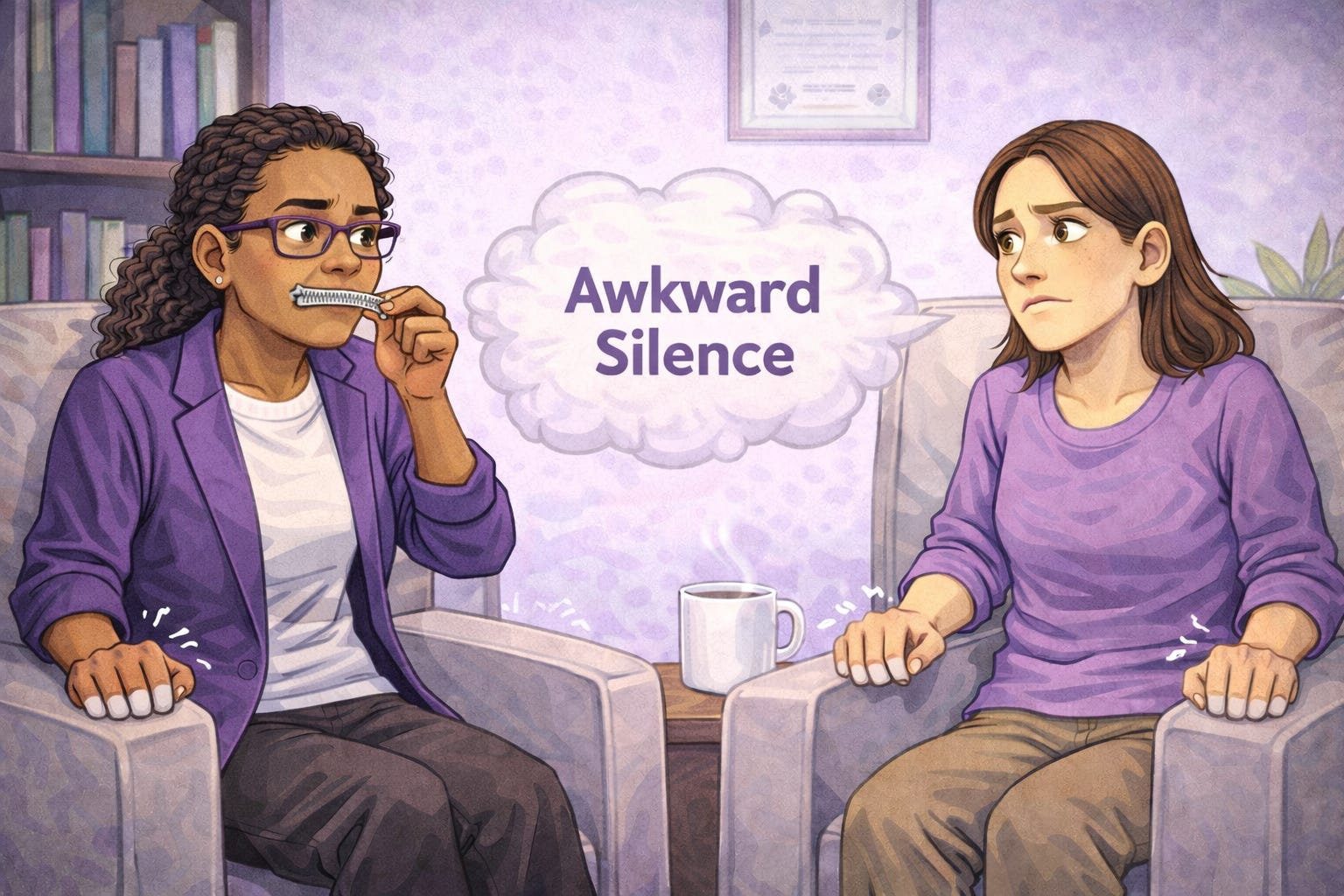
It’s agonizing. It’s humbling. And it works.
Self-disclosure isn’t the enemy. It’s a tool. A spice. And like nutmeg, it should be used sparingly and with great care, lest you ruin the entire dish. When it’s used with intention and restraint, it can help clients feel seen and less alone. Alternately, when it’s driven by our own unconscious need to relate, rescue, or feel interesting it muddies the waters and is less effective.
So, the next time you feel the urge to share, try this: Wait. Breathe. Ask yourself if this is really for your client, or if it’s for you. And if you’re not sure?
Don’t just say something. Sit there.
Your Turn
How do you manage the impulse to self-disclose? Have you found a rule, a mantra, or an internal eyebrow raise that helps you keep yourself in check? Drop your best WAIT strategies—and your worst overshare regrets—in the comments. We’ve all been there. Let’s talk about not talking.

Patients often ask us personal questions. I usually respond, "Before I answer that, tell me why that is important." After that, they often forget they've asked me the question.
Silence often does more work than anything we might add.🤍