

Emotional Intelligence Is Having a Moment.
Let’s Not Waste It.
THE EMPOWERED THERAPIST - TWO PART SERIES
PART ONE OF TWO
On why people are Googling “emotional intelligence” without being told to, what the research actually says, and why this cultural moment is more hopeful than it looks.

There is a subreddit called r/EmotionalIntelligence. It has hundreds of thousands of members. People post in it earnestly, vulnerably, and without very much irony at all.
And if you know Reddit, you know that’s sort of unusual. Reddit is a place where, for the most part, sincerity is treated with roughly the same suspicion as a free candy van. Communities form around the shared project of being the funniest, most detached person in the room. And yet here, in this one corner of the internet, people are showing up and going: I want to understand my emotions better. I want to be more aware. I want to be, in the most earnest possible sense of the phrase, emotionally intelligent.
And they’re doing it, in a lot of cases, without a therapist. Without a clinical framework. Without even necessarily knowing that what they’re reaching for has a name, a history, and a fairly robust body of research behind it.
They just know they want it.
That’s interesting. And it’s worth paying attention to.
Emotional intelligence (Or EI if you want to sound like you work in an HR department, EQ if you prefer the version that sounds like a personality quiz) is, at its most basic, the ability to recognize, understand, manage, and tolerate emotions. Your own, and other people’s.
The concept was formally named in 1990 by psychologists Peter Salovey and John Mayer.

That concept was then spectacularly popularized in 1995 by Daniel Goleman, who wrote a book about it that sold approximately five million copies and became the kind of thing that gets quoted in corporate leadership trainings for the next three decades. It’s not new. What’s new is that regular people, not executives, not MBA candidates, not people whose employers have sent them to a workshop, are now actively seeking it out.
Goleman broke EI into five components that have become the rough shorthand for the whole concept: self-awareness, self-regulation, motivation, empathy, and social skills. You can argue with the framework. Plenty of researchers do. But as a map of the emotional territory most of us are trying to navigate without a GPS, it’s pretty good.
What it is not is a fixed trait you either have or don’t. This is the part worth underlining. Unlike IQ, which is relatively stable and stubbornly resistant to change, emotional intelligence is learnable. Developable. Something you can actually get better at, with practice, intention, and (of course), therapy if you’re lucky enough to have access to it. Also: without therapy, if you’re not.
The Reddit people are onto something. Emotional intelligence is a real, researched, developable skill and now people are seeking it out intuitively, without clinical scaffolding.
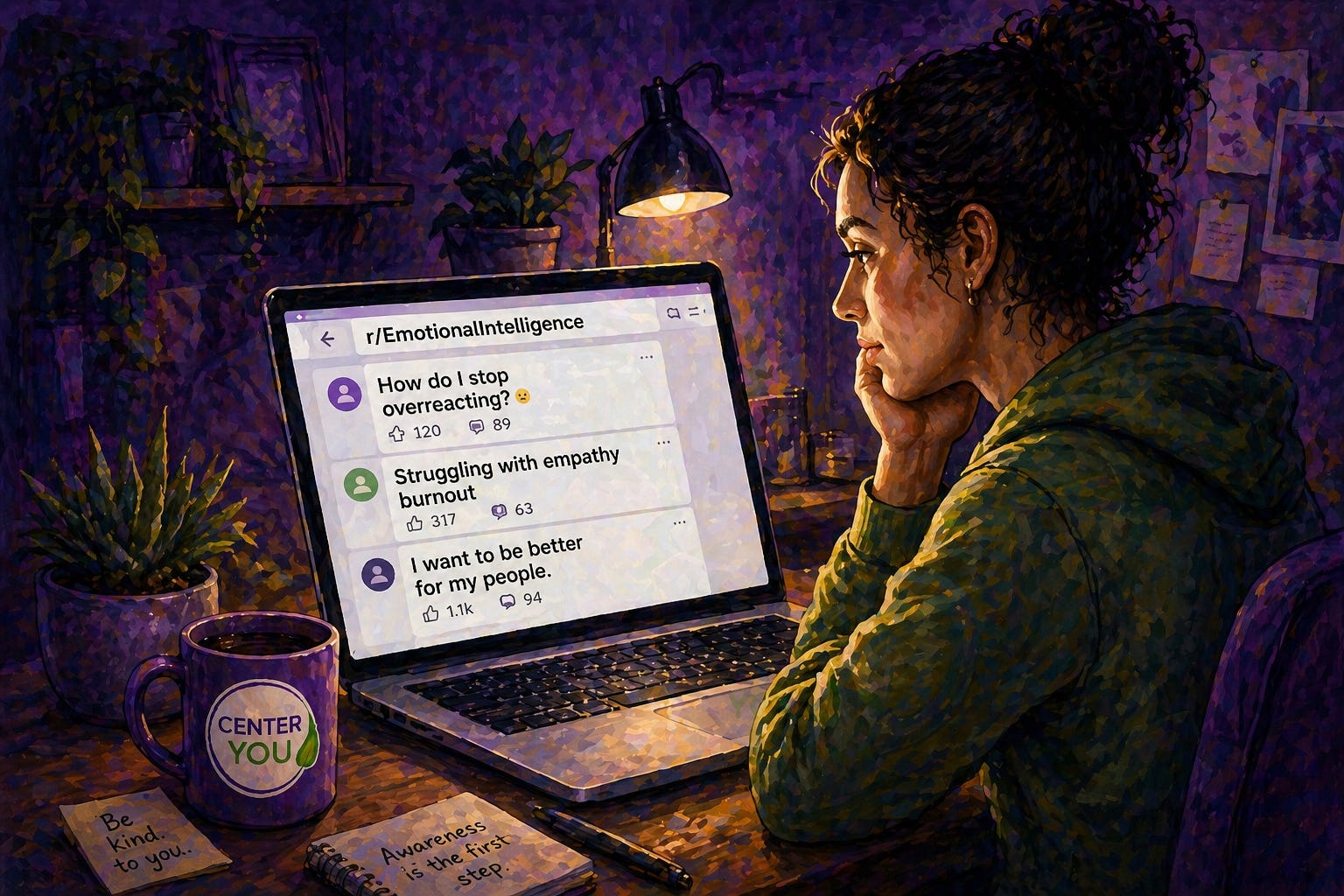
They are doing this because they are feeling the absence of something. They are trying to build, from scratch and from wherever they can find the materials, a skill set that nobody gave to them.
That instinct deserves to be taken seriously.
The fact that emotional intelligence is having a cultural moment right now is not an accident. It’s a response to something.
We have lived, for a very long time, inside systems (workplaces, families, educational institutions, entire cultures) that were built on the premise that emotions are noise. That the goal is to minimize their interference, to get through the feeling and back to the function as quickly as possible. The ideal, in these systems, was a kind of emotional efficiency: feel as little as possible, express even less, keep moving.
The cost of this has been enormous and it is not subtle anymore. We’re watching the downstream consequences of generations of emotional suppression in real time: the loneliness epidemic, the mental health crisis, the staggering rates of burnout, the political polarization that is, at least in part, a function of people who never learned to tolerate the discomfort of encountering a perspective different from their own. These are not separate problems. They are the same problem, wearing different clothes.
Emotional intelligence is one of the most robust predictors we have of, depending on the study, relationship satisfaction, career success, physical health, mental well-being, and the ability to navigate conflict without it becoming catastrophic. People who score high in EI are better at managing stress, better at communicating, better at building and maintaining the kinds of relationships that actually sustain a person through a life. This is not soft science. This is outcome data. The kind that shows up in peer-reviewed meta-analyses, replicated across tens of thousands of participants, published in journals that require you to show your work. If you want to go looking, start with the research on EI and relationship satisfaction (Schutte et al., 2022), EI and career outcomes (Sánchez-Álvarez et al., 2023), and EI and workplace performance (Miao et al., 2022). The receipts exist. There are a lot of them.
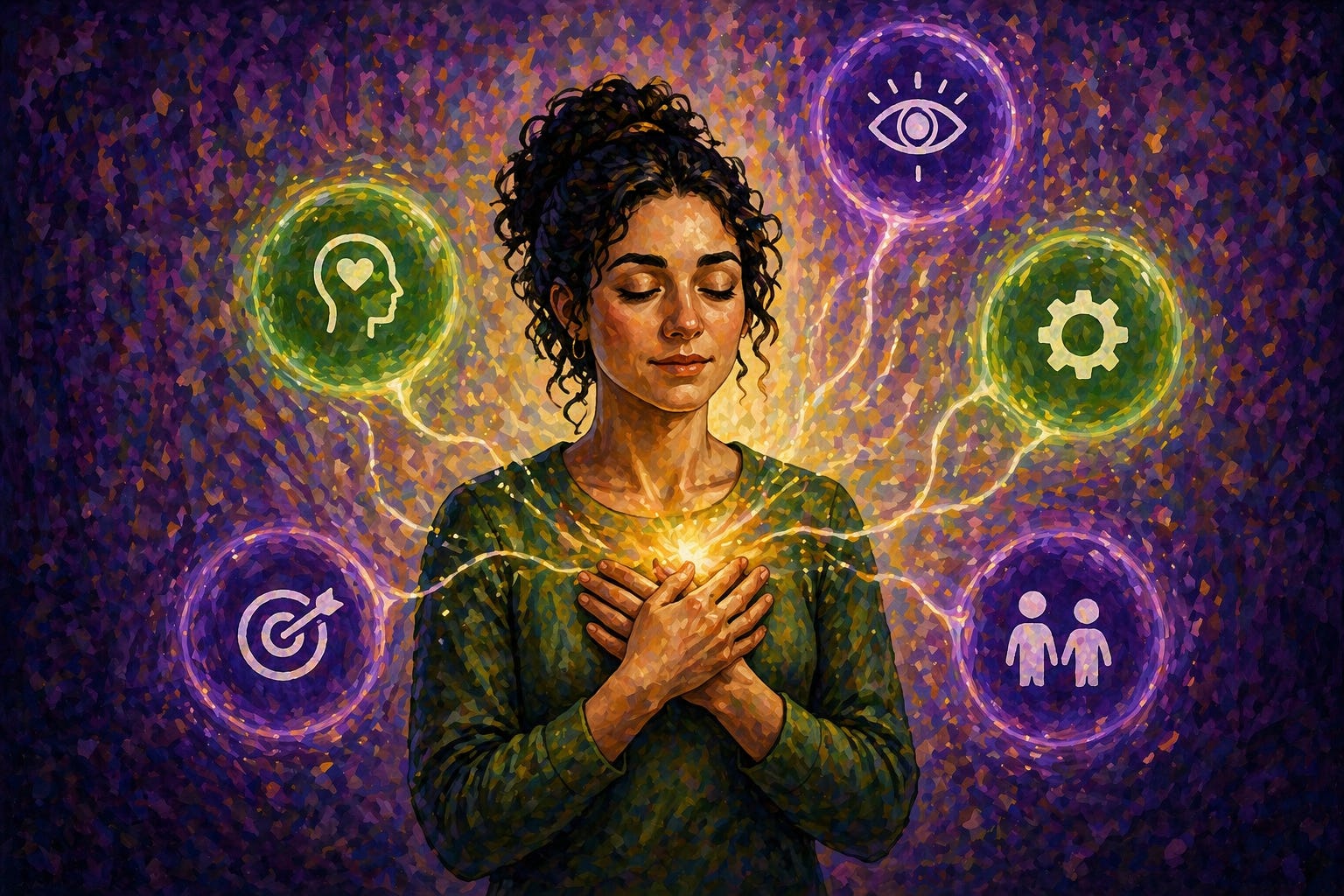
So when people start gravitating toward this concept on their own, without being sent to a workshop or prescribed a framework, something real is happening. The fact that they’re finding it on Reddit of all places and sitting with it earnestly, is, without exaggeration, one of the more hopeful things happening right now.
Emotional intelligence in practice is less dramatic than it sounds in a business book. It doesn’t look like being the wisest, calmest person in every room. It doesn’t look like never getting upset.
It looks like pausing. Not forever. Just long enough. That gap between feeling and responding is where emotional intelligence lives. It’s not the absence of emotion. It’s the ability to be with the emotion long enough to decide what to do with it.
It looks like curiosity. About your own reactions, about other people’s, about why a given moment landed the way it did.
It also looks like being honest, with yourself and sometimes with others about your own emotional state. Not as a performance of vulnerability (the therapy-speak version of emotional intelligence, which is its own problem and we’ll get to that another time), but as a genuine act of self-awareness. I am anxious right now. I am sad about this. I need to step away for a minute. These are not complicated sentences. And they are, for a lot of people, some of the hardest sentences to say.
The world does not have an information problem. We have access to more information than any previous generation of humans. We know, with considerable precision, what is happening and why. What we have (and have always had), what is becoming increasingly visible in its consequences: a relational problem. A capacity-for-empathy problem. An inability-to-tolerate-complexity problem.
Emotional intelligence does not fix all of this. Let’s be real. It’s not a political platform or a foreign policy or an economic system. It is a foundation. Because empathy and the capacity to understand and be moved by the experience of another person, especially a person who is different from you, is the precondition for almost every good thing we want in a society. Justice requires it. Democracy requires it. Parenting requires it. Friendship requires it. Any relationship that is going to sustain and grow across time and difference requires it.
Empathy is not a personality trait you either have or don’t. It is a skill. It atrophies without practice and it develops with use. This is one of the most important things we know about human beings, and it is one of the things we are worst at teaching.
Emotional intelligence is not a trend. It is not therapy-speak for people who can’t handle real life. It is not soft. It is not new. It is one of the most empirically well-supported constructs in psychology, and it is becoming more culturally visible precisely because people are hungry for it.
We are, as a culture, slowly and imperfectly and somewhat chaotically, starting to recognize that the emotional dimension of being human is not a bug to be managed. It is a feature. It always was. We spent too long pretending otherwise.
People are finding emotional intelligence on Reddit, of all places FFS. And they’re sitting with it, earnestly, without irony. That’s not nothing. It’s actually kind of everything.
Next up in Part Two: we’re going to talk about why it took us this long. About the word that got weaponized to make emotional awareness look like weakness. About how “sensitive” became an insult and what it actually cost us when it did.
Let’s Fucking Talk
Where did you first encounter the idea of emotional intelligence? Was it something you actively sought out, or something that found you? We want to hear it. The comments are open.
This one really landed. A clear reminder that emotional intelligence isn’t about controlling everything we feel, but understanding it and choosing how we show up. Simple in concept, hard in practice… and worth the work every day.